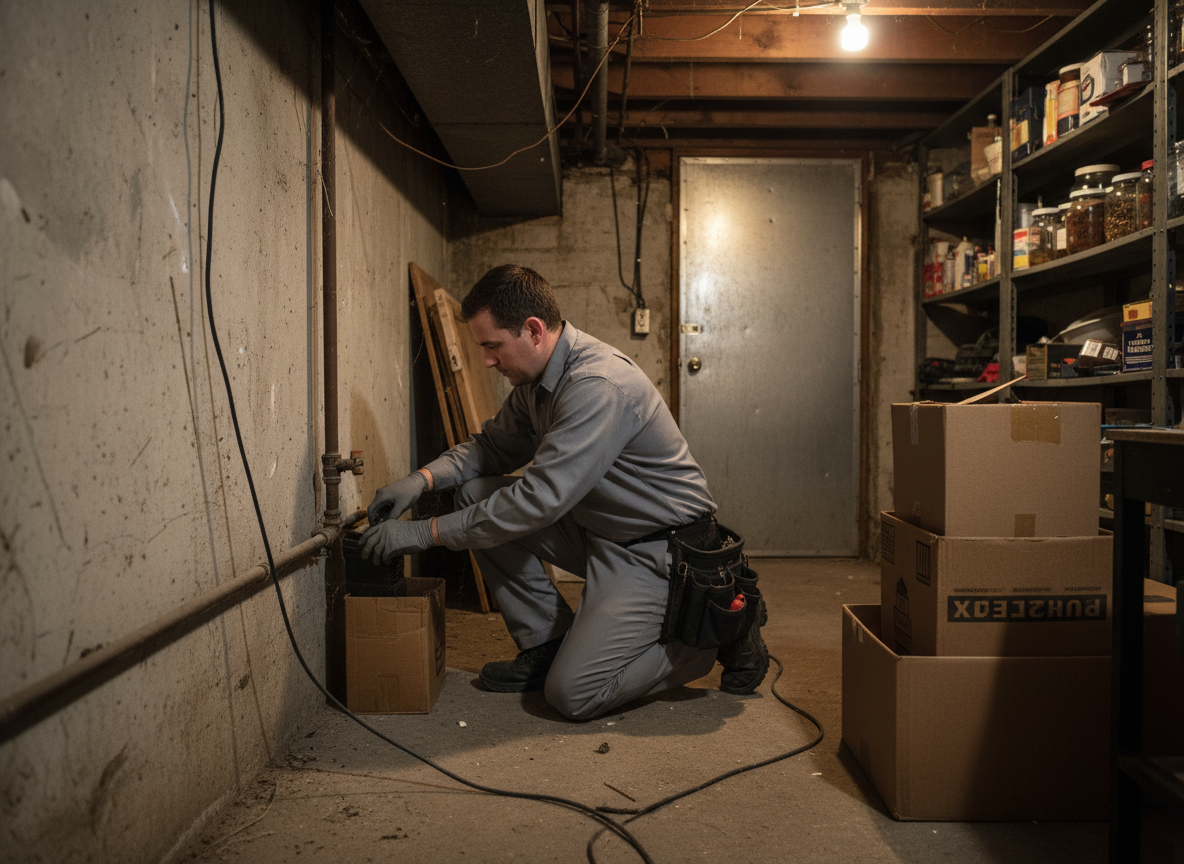
Basements in Marietta neighborhoods like Forest Hills and Downtown Marietta often feature older poured concrete or stone foundations that shift with the area's humid subtropical climate. Mild winters allow rats and mice to remain active rather than seeking deep shelter, while summer humidity encourages nesting in insulation and stored items. Technicians focus on locating utility penetrations and expansion joints where rodents enter from the exterior grade, which sits close to the foundation in many Cobb County lots.
Rodent activity increases around Glover Park and Marietta Square properties because nearby green spaces and Kennesaw Mountain provide travel corridors. Homeowners frequently discover droppings near water heaters or along sill plates after periods of heavy rain, when soil moisture pushes rodents upward. Effective control requires both interior trapping and exterior exclusion work that accounts for the red clay soil's tendency to erode around foundation walls over time.
In homes built before the 1980s in Whitlock Heights and nearby sections of Smyrna, basement rodent jobs commonly involve replacing chewed HVAC duct insulation and sealing around sump pits. These older structures have more gaps than newer builds, and the consistent mild temperatures mean exclusion work must hold up year-round without seasonal relief. Crews inspect from the interior first, then address exterior grading to reduce future pressure on the foundation.
Technician insight
In Marietta, the thing that catches most people out with Basement Rodent Control is how the red clay soil around older foundations in places like Whitlock Heights erodes during heavy summer rains, reopening sealed gaps that homeowners thought were fixed after a mild winter.
Forest Hills Basement With Recurring Mice
Homeowners noticed droppings near the water heater in their 1960s Forest Hills house after a wet spring. Inspection revealed gaps at the sill plate where shifting soil had pulled away from the foundation. Crews sealed the perimeter, installed sump pit covers, and set traps along the wall. Activity stopped within two weeks and no new signs appeared after the next rain cycle.
Basement Rodent Control Services We Offer
✓Foundation Crack Sealing
Locate and seal hairline cracks and utility penetrations in basement walls common to Marietta's older concrete foundations.
✓Sump Pit Rodent Barriers
Install custom-fit covers and mesh barriers over sump pits to block entry while maintaining proper drainage in humid Cobb County conditions.
✓Insulation Removal and Replacement
Remove contaminated fiberglass or cellulose insulation from basement walls and replace it after rodent activity is eliminated.
✓Exterior Perimeter Exclusion
Address gaps at the exterior grade around basements in neighborhoods like Forest Hills to prevent re-entry from nearby green spaces.
✓Debris and Nest Removal
Clear accumulated debris, nesting material, and droppings from crawlspaces and unfinished basements to eliminate attractants.
How it works
- 1
Detailed Basement Inspection
Technicians examine walls, floors, and utility entries in homes throughout Marietta to identify current and potential rodent pathways.
- 2
Entry Point Mapping
Map all gaps and cracks, noting how local soil conditions and foundation age affect rodent access in Cobb County basements.
- 3
Targeted Trapping And Exclusion
Place traps in active zones and seal openings using materials suited to the area's humidity and temperature swings.
- 4
Follow-Up Monitoring
Return visits confirm activity has stopped and check that seals remain intact after seasonal weather changes.
Pricing
Cost depends on basement size, number of entry points, and whether insulation replacement is required.