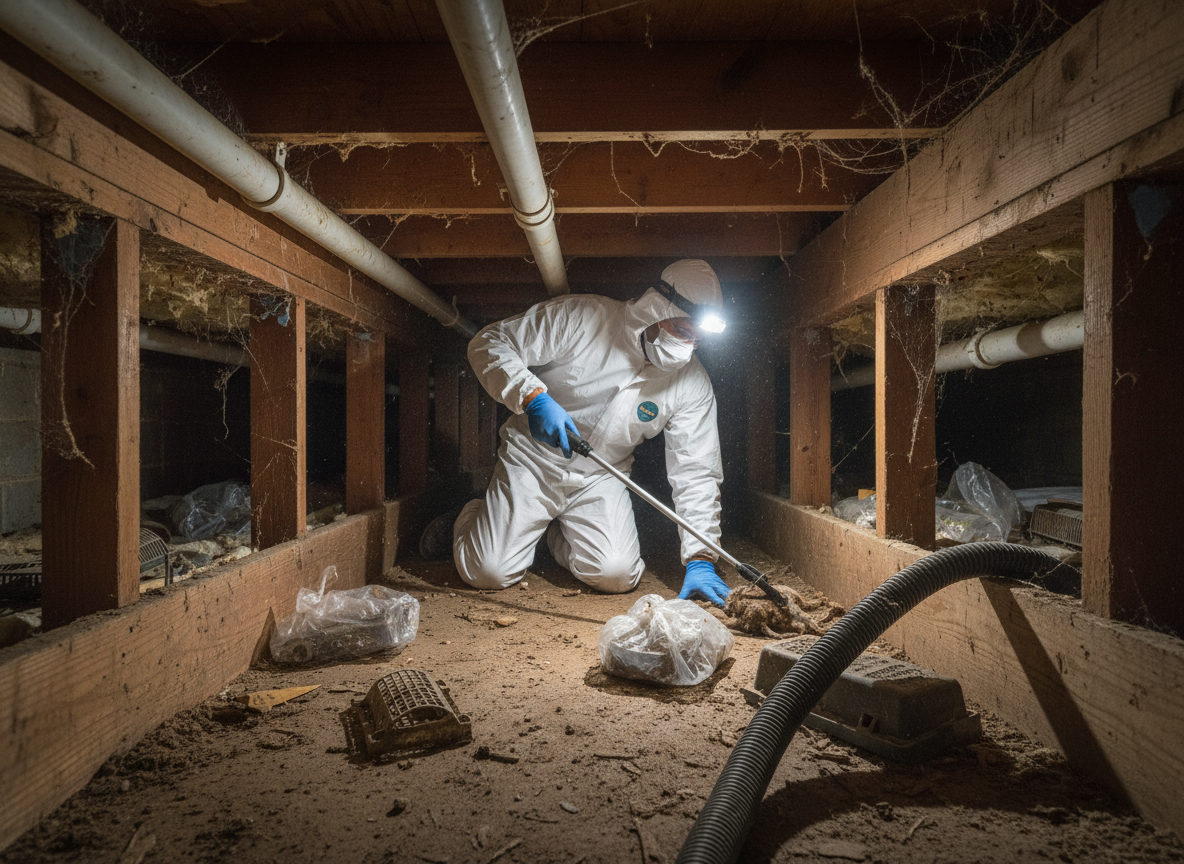
Marietta’s older neighborhoods like Whitlock Heights and Forest Hills feature many homes built before 1970 with vented crawl spaces that sit close to damp soil. The region’s humid subtropical climate keeps these spaces moist year-round, giving roof rats and house mice steady access to food scraps and nesting material. Technicians begin by sealing utility penetrations and installing heavy-gauge hardware cloth over vents, then place tamper-resistant bait stations along the sill plate where rodents travel. In properties near Marietta Square or Glover Park, crews also check for gaps created by settling foundations common on the area’s clay-heavy soil.
Homeowners in nearby Smyrna and Rosemont often discover droppings during HVAC filter changes because rodents use ductwork in crawl spaces as travel routes. Removal work includes vacuuming insulation contaminated by urine and feces, followed by installing a vapor barrier to reduce future moisture that draws insects and rodents. Edge cases include active wasp nests or low clearance that requires belly boards and headlamps; crews never apply rodenticides near wells or septic systems without containment trays.
Cobb County building codes require that any new crawl-space access doors meet fire and pest standards, so technicians replace damaged doors with metal-framed units that include self-closing latches. After trapping is complete, follow-up visits confirm no new activity before recommending quarterly monitoring for homes backing up to Kennesaw Mountain green space where wildlife pressure remains high.
Technician insight
In Marietta, the thing that catches most people out with Crawl Space Rodent Removal is how quickly roof rats move from the Kennesaw Mountain tree line into Whitlock Heights crawl spaces once summer humidity spikes. Homeowners often seal only the obvious vents but miss the gaps around old cast-iron pipes that settle on clay soil, so rodents keep re-entering even after trapping.
Forest Hills Home With Recurring Rat Activity
A homeowner in Forest Hills noticed droppings near the HVAC return after heavy summer rains. Inspection revealed roof rats entering through a rotted vent and traveling along moist joists. Crews sealed all vents with hardware cloth, installed a vapor barrier, and placed stations along the sill plate. Activity stopped within ten days and no new signs appeared on the follow-up visit.
Crawl Space Rodent Removal Services We Offer
✓Crawl Space Rat Removal
Targets larger roof rats that travel along sill plates and joists in Marietta crawl spaces using heavy-duty snap traps and secured bait stations.
✓Crawl Space Mouse Removal
Focuses on house mice that exploit small gaps around plumbing and wiring with multiple-catch traps placed along runways.
✓Crawl Space Entry Point Sealing
Closes foundation vents, utility gaps, and door frames with galvanized hardware cloth and metal flashing to stop new rodent access.
✓Contaminated Insulation Removal
Extracts rodent-soiled insulation from crawl spaces and replaces it after sanitizing joists and subflooring to restore air quality.
✓Crawl Space Vapor Barrier Installation
Lays 12-mil reinforced polyethylene sheeting over soil to cut moisture that attracts rodents and supports long-term exclusion.
How it works
- 1
Inspection
Technician enters the crawl space to map rodent runs, identify entry points, and note moisture conditions typical of Marietta’s clay soil.
- 2
Exclusion
All vents and gaps are sealed with metal mesh before any trapping begins to prevent new rodents from entering during treatment.
- 3
Trapping and Removal
Snap traps and bait stations are placed along established runways; captured rodents are removed and disposed of off-site.
- 4
Sanitation and Follow-Up
Contaminated material is removed, surfaces sanitized, and a return visit scheduled to confirm activity has stopped.
Pricing
Pricing varies by home size, extent of infestation, and whether insulation removal is required.